
-
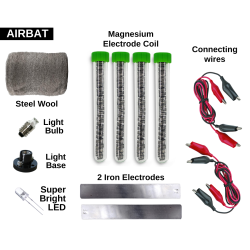 AIRBATAir/Saltwater Battery Kit$27.50
 KITECElectricity & Conductivity$25 - $195
 KITEMElectromagnet Science Kits, Basic$15 - $900
 KITMEMake Electricity Science Kit$28 - $900
 KITME-AMM360Make Electricity Science Kit Multimeter AMM360$33 - $2673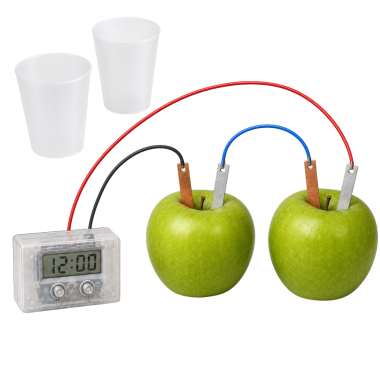
Fruit Powered Digital Clock STEM Electrochemistry Project - APPLES CLOCK
Demonstrates fruit-based galvanic cells and series circuitsSKU: APPLECLOCKAPPLES CLOCK – Fruit-Powered Digital Clock STEM Electrochemistry Project
This educational electrochemistry kit uses two pieces of fruit as galvanic cells to operate a digital clock module. Copper and zinc electrodes placed in the fruit create a small electrical current through the acidic electrolyte, while a series connection combines the cell voltages to run the display.
Product Specifications
Product Type Fruit-powered digital clock STEM science project Recommended Age 14 years and up Power Source Two fruit-based electrochemical cells connected in series Clock Module Digital clock module with attached red and black wires Electrodes Copper strips and zinc strips Electrolyte Fruit acid from apples or other conductive fruit and liquid sources Series Connection Middle connecting wire joins copper of one cell to zinc of the other cell Polarity Red wire connects to copper positive; black wire connects to zinc negative Included Components Digital clock module, connecting wire, 2 clear test-tube pots, copper strips, zinc strips, transparent adhesive tapes, and instruction manual User-Supplied Materials Two fresh apples; optional lemon, orange, tomato, salt water, or fruit juice for experiments Clock Controls Two buttons marked A and B for starting, setting month, day, hour, minute, viewing date, and viewing seconds Initial Display Static 12:00 when the metals are first inserted into the apples Subject Areas Chemistry, physics, electricity, and the scientific method Instructional Setting Middle school, high school, introductory college lab, home study, classroom activity, and science-fair entry Applications and Benefits:
- Demonstrates how a galvanic cell converts chemical energy into electrical energy.
- Identifies copper and zinc as electrodes and fruit acid as the electrolyte.
- Shows why two cells connected in series increase voltage for operating the clock.
- Supports construction of a simple electrical circuit using red positive and black negative clock leads.
- Uses the clock display as an observable indicator of current flow.
- Supports hypothesis testing by changing one variable, such as fruit type or liquid electrolyte.
- Allows comparison of apples, lemon, orange, tomato, salt water, and fruit juice as conductive power sources.
- Supports data recording by noting whether the clock starts and how bright the display appears.
- Supports ranking power sources from strongest to weakest and writing a results-based conclusion.
- Provides a classroom, home study, laboratory, or science-fair activity for electrochemistry and circuits.
Caution:
Educational science project. Not a toy. Recommended for ages 14 and up with adult supervision required at all times. Read all instructions before use. Contains small parts and metal strips with sharp edges; handle with care and keep away from children under 14 and pets because small parts are a choking hazard. Do not place fruit, wires, or metal strips in the mouth, and do not eat fruit after use. Do not connect any part of the kit to a wall outlet, household current, or standard batteries because doing so can cause electric shock. Wash hands after handling fruit and metal strips. Keep copper and zinc plates from touching inside the fruit, and keep wires or strips from touching outside the fruit to prevent short circuits. The clock may temporarily lose its display in an electrostatic discharge environment; normal function returns once the clock is reset.
- Availability: In Stock
- Model: APPLECLOCK
-
Brand:

- acidic fruit
- apple batteries
- apple battery
- apple clock
- apple powered clock
- apple-powered clock
- APPLECLOCK
- apples clock
- chemistry
- circuit
- circuits
- classroom lab
- college lab
- copper electrode
- copper electrodes
- current
- digital clock
- electricity
- electrochemistry
- electrodes
- electrolyte
- electrolytes
- fruit acid
- fruit batteries
- fruit battery
- fruit clock
- fruit clocks
- fruit powered clock
- fruit-powered clock
- galvanic cell
- galvanic cells
- Green Science
- GreenScience
- high school
- home study
- middle school
- physics
- polarity
- school lab
- science fair
- science fairs
- science kit
- science kits
- science project
- science projects
- scientific method
- series circuit
- series circuits
- STEM
- STEM kit
- STEM kits
- voltage
- voltaic cell
- voltaic cells
- zinc electrode
- zinc electrodes


